








Email deliverability starts long before an email is sent.
Most teams focus on infrastructure, domain reputation, authentication records, and content optimization. While those are all important, there's another problem that quietly destroys deliverability and campaign performance:
Poor email data quality.
At Keplars, email validation is a critical part of our communication infrastructure. Before building our own validator, we evaluated and used multiple third-party validation providers. They worked reasonably well for basic checks, but we consistently ran into the same challenge - many platforms were unable to reliably determine whether an email address was actually capable of receiving mail.
For us, that wasn't good enough.
When sending transactional emails, onboarding sequences, marketing campaigns, or automated workflows, every invalid email address affects several areas.
- Deliverability rates
- Sender reputation
- Bounce rates
- Campaign performance
- Infrastructure costs
After testing numerous solutions and validation approaches, we decided to build our own.
That project eventually became Pluto.
The Problem with Traditional Validation:
Most email validation tools stop at basic checks such as email format validation, domain existence, MX record lookup, and disposable email detection.
While useful, these checks alone don't provide enough confidence that an address is truly valid. The format may be correct, the domain may exist, and MX records may be configured correctly - but none of those checks guarantee that the mailbox itself is valid or deliverable.
We needed something more comprehensive.
Building Pluto:
Pluto was developed internally using Go to provide fast, scalable, and highly accurate email validation.
The objective was simple: validate email addresses as thoroughly as possible before they ever enter our sending pipeline.
Rather than relying on a single signal, Pluto combines multiple validation layers into a unified scoring and verification process.
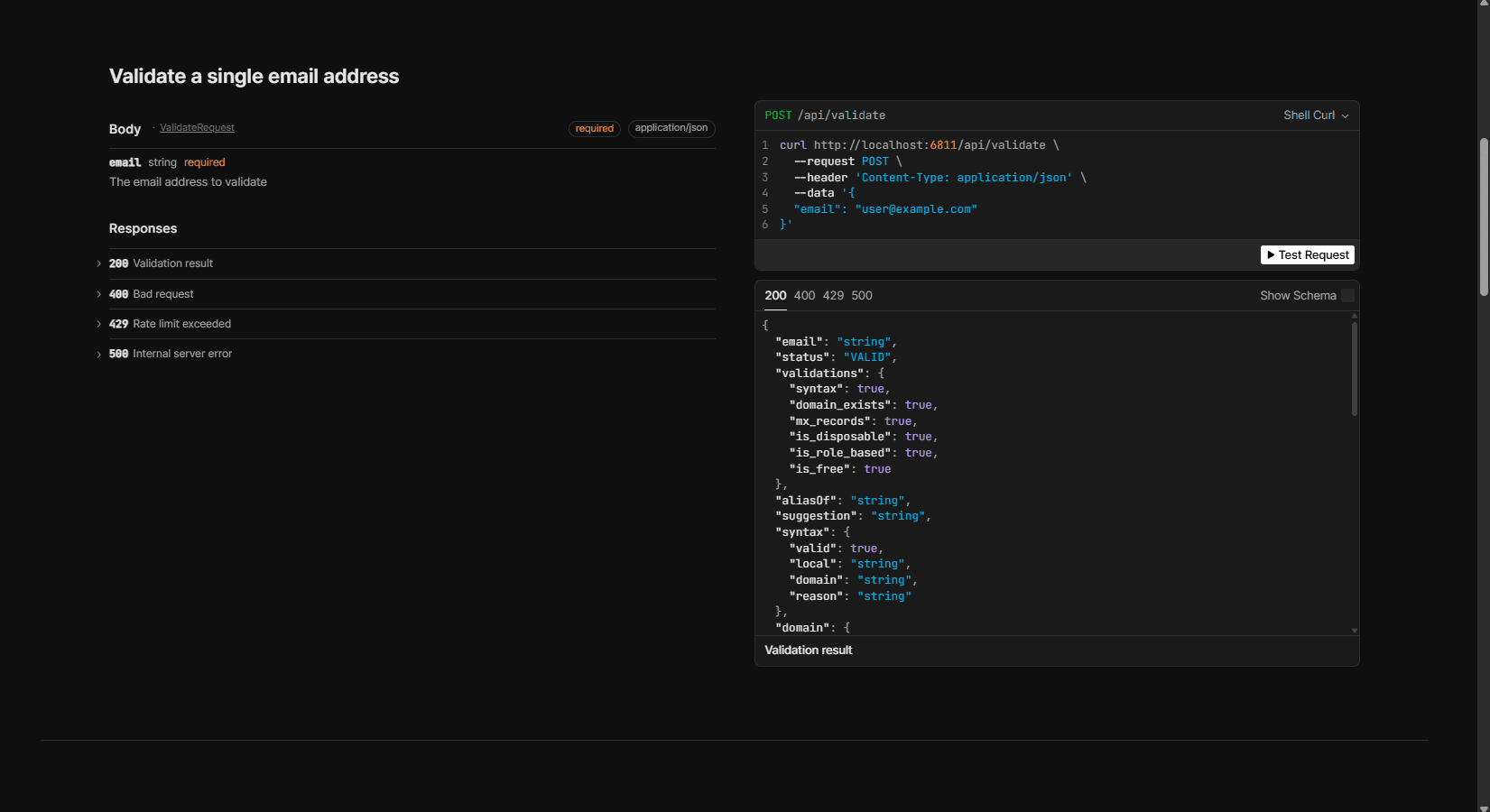
What Pluto Checks:
RFC Compliance:
Every email address is validated against RFC standards to ensure it follows proper formatting rules, including local-part validation, domain validation, character restrictions, and length requirements.
Length Limit Validation:
Many validation systems ignore practical mailbox limitations. Pluto verifies local-part length, domain length, and overall email length against accepted standards.
Internationalized Domains (IDN):
Modern email systems increasingly support internationalized domain names. Pluto validates Unicode domains, IDN domains, and Punycode conversions, ensuring compatibility across global email providers.
DNS and MX Validation:
A valid domain should be capable of receiving mail. Pluto performs DNS lookups, MX record validation, and domain routing verification before proceeding further.
Disposable Email Detection:
Temporary email services create significant challenges for many applications. Pluto maintains a database of 5,000+ known disposable and throwaway email providers and continuously checks addresses against them.
Role-Based Email Detection:
Role accounts often indicate shared inboxes rather than actual users. Pluto identifies and flags these addresses appropriately.
Free Provider Detection:
We also identify major consumer providers including Gmail, Outlook, Yahoo, iCloud, ProtonMail, and many others. This allows systems to distinguish between business and personal email addresses when necessary.
Alias Normalization:
Email aliases create another layer of complexity. For example, the following addresses often resolve to the same mailbox.
Pluto performs provider-specific normalization for Gmail dot aliases, Gmail plus tags, Yahoo aliases, iCloud aliases, and additional provider-specific behaviors. This significantly improves duplicate detection and data cleanliness.
Typo Detection:
A surprisingly high percentage of invalid emails are caused by simple typing mistakes. Pluto automatically identifies common domain typos and provides suggested corrections.
Reputation Analysis:
Beyond mailbox validation, Pluto evaluates domain reputation signals including SPF records, DMARC records, DNS reputation indicators, DNSBL checks, and DBL checks. This provides additional insight into the overall quality of the sender domain.
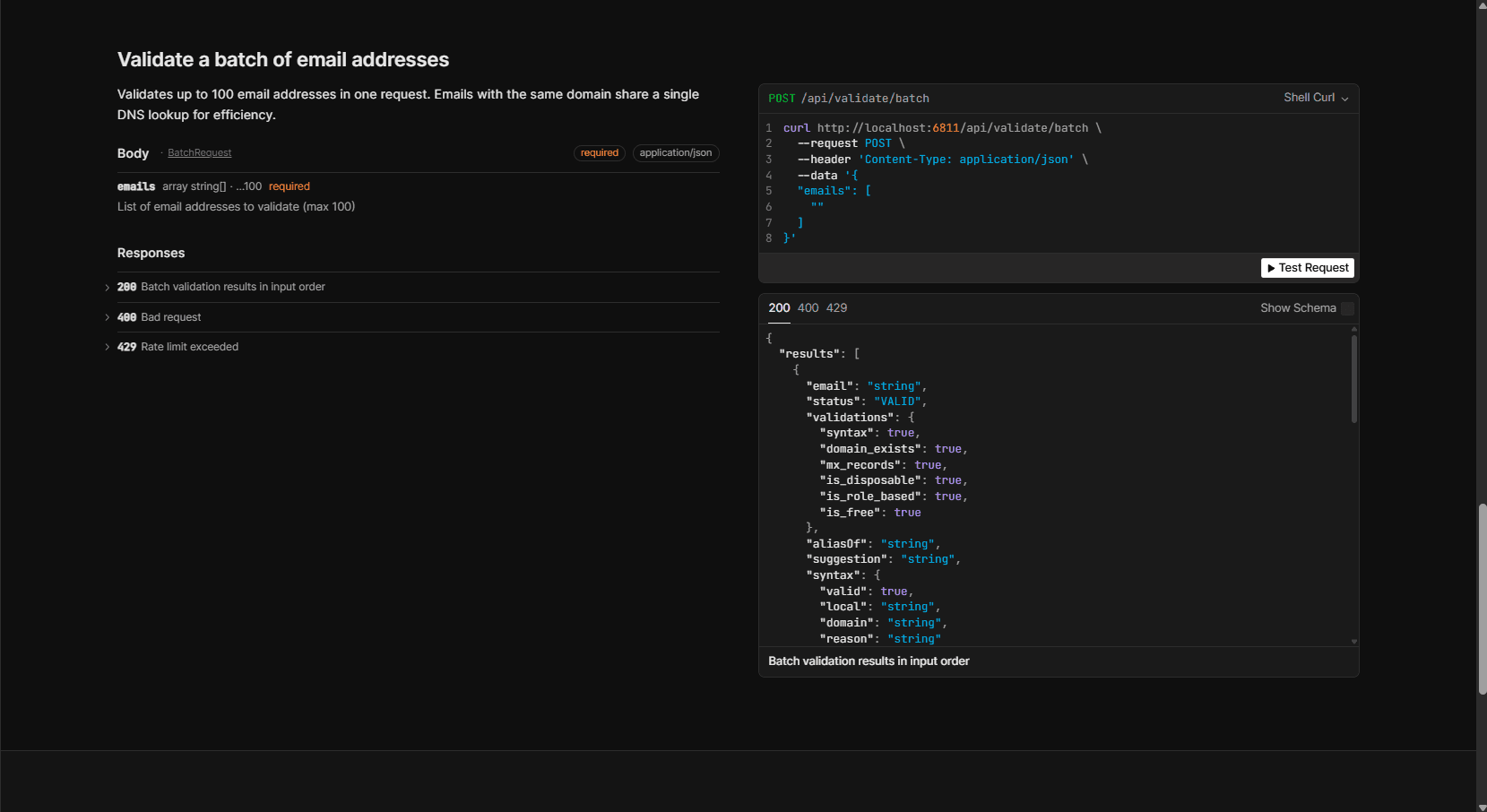
Batch Domain Validation:
For larger datasets, Pluto performs validation at scale, enabling bulk email verification, lead list cleaning, campaign preparation, and data quality audits without sacrificing accuracy.
SMTP Mailbox Verification:
One of the most important layers. Pluto performs mailbox-level SMTP verification where supported, helping determine whether the destination mailbox actually exists and is capable of receiving mail.
While no validation system can guarantee 100% accuracy due to provider-specific protections and anti-abuse mechanisms, mailbox verification dramatically improves confidence compared to format-only validation.
The Results:
After implementing Pluto into our internal workflows, validation accuracy improved significantly. We became far more confident in the quality of email data entering our communication infrastructure.
This translated into several key benefits.
- Better deliverability
- Lower bounce rates
- Cleaner datasets
- Improved sender reputation
- More reliable automation workflows
Today, Pluto helps us achieve over 90% validation accuracy across our internal validation pipeline.
Why the Name Pluto?
At Keplars, many of our internal systems follow a space-themed naming convention. Since this validator quietly operates in the background while helping navigate email quality across the ecosystem, Pluto felt like the perfect fit. Small. Fast. Reliable. And constantly working behind the scenes.
What's Next?
Today, Pluto remains an internal tool used by the Keplars team. We continue improving validation accuracy, detection systems, reputation analysis, disposable provider coverage, and mailbox verification logic.
As our email infrastructure platform grows, Pluto continues to play a critical role in helping maintain high-quality communication data.
Because in email infrastructure, what happens before sending is often just as important as what happens after.