







When developers evaluate a platform, the first question is rarely about features.
It's usually much simpler:
"How quickly can I integrate this into my stack?"
No matter how powerful a platform is, adoption becomes difficult if developers need to spend hours reading API documentation, writing custom wrappers, or handling low-level HTTP requests.
At Keplars, we've always believed that email infrastructure should be easy to integrate, regardless of the language or framework you're using.
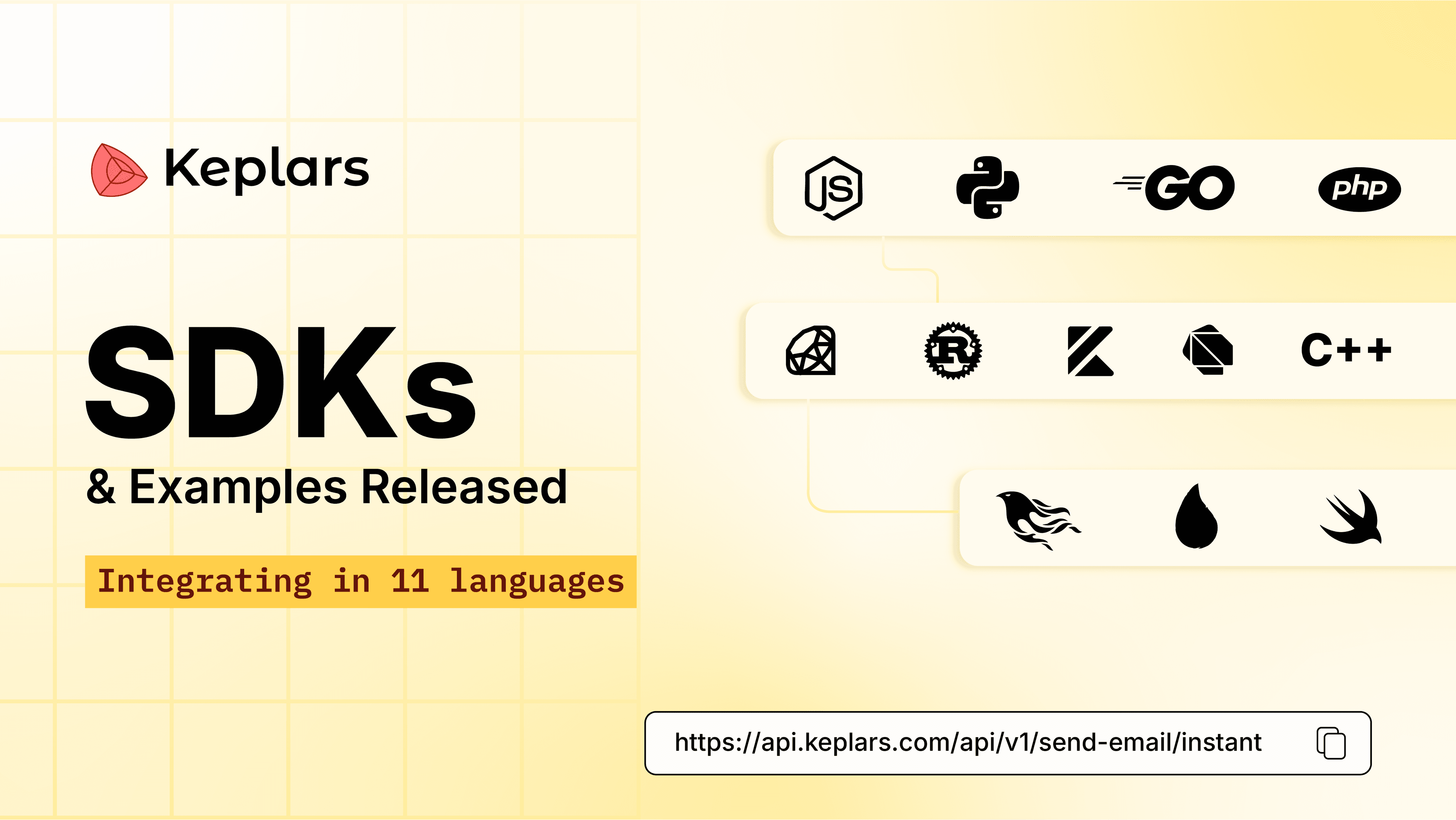
That's why we're excited to announce the release of official Keplars SDKs and examples across 11 programming languages, making it easier than ever for developers to integrate email delivery into their applications.
Why SDKs Matter
Modern development teams work across a diverse ecosystem of languages and frameworks. Some teams build backend services in Go. Others rely on Node.js, Python, PHP, or Ruby. Mobile developers often work with Flutter or Swift, while performance-focused teams may prefer Rust or C++.
While our REST API is available to everyone, developers shouldn't have to build custom integrations every time they want to send an email.
A well-designed SDK provides:
- Faster integration
- Better developer experience
- Strong typing and validation
- Cleaner codebases
- Easier maintenance
- Consistent implementation patterns
In short, SDKs allow developers to focus on building products instead of infrastructure.
Official SDKs Available Today
Keplars now provides SDKs and examples for:
- Node.js
- Python
- Go
- PHP
- Ruby
- Rust
- Kotlin / Java
- Dart / Flutter
- Elixir / Phoenix
- C++
- Swift (iOS)
Whether you're building a SaaS platform, mobile application, AI product, marketplace, or internal business tool, there's now a native way to integrate Keplars into your workflow.
One Goal: Get Developers Productive Faster
The purpose of these SDKs isn't simply to support more languages. The goal is to reduce the time between creating a Keplars account and sending your first email.
Instead of spending hours configuring integrations, developers can install an SDK using their preferred package manager and begin sending emails within minutes.
Node.js
Python
Go
PHP
This simple experience is something we wanted to provide consistently across every supported language.
More Than SDKs
While SDKs are often the fastest path to integration, we understand that every team has different requirements. Some organizations prefer direct API calls. Others rely on SMTP-based workflows. Many teams work within established frameworks and want examples tailored to their environment.
That's why we've also released a comprehensive collection of examples covering multiple integration patterns.
Developers can find examples for:
- Express.js
- Flask
- Laravel
- Rails
- Phoenix
- Flutter
- Kotlin
- Swift
- Native HTTP clients
- SMTP implementations
- REST API integrations
The objective is simple: meet developers where they already are.
Supporting Modern Development Workflows
Today's applications are built differently than they were a decade ago. A single product might include:
- A React frontend
- A Node.js API
- Python AI services
- Mobile applications built with Flutter
- Background workers written in Go
- Internal tools running on PHP
Email communication often spans all of these systems. By providing SDKs across multiple ecosystems, Keplars allows teams to maintain a consistent email infrastructure regardless of the technology stack behind each service.
Built for Production
Developer experience is important, but reliability matters even more.
Every SDK is designed to work seamlessly with the Keplars platform, enabling developers to build:
- Transactional email systems
- Authentication workflows
- Verification emails
- Password reset flows
- Marketing campaigns
- Notifications and alerts
- Scheduled email workflows
All while leveraging the same underlying infrastructure.
Why This Release Matters
Email remains one of the most important communication channels on the internet. Yet integrating email into an application often involves dealing with multiple providers, authentication methods, API implementations, and framework-specific challenges.
Our goal with these SDKs is to remove that complexity. Developers should be able to choose the tools they love and still have access to reliable email infrastructure without additional friction.
This release is a significant step toward that vision.
What's Next
Supporting 11 languages is not the finish line. We'll continue improving our SDKs, expanding examples, enhancing documentation, and building tools that make email infrastructure easier for developers around the world.
Whether you're building your first side project or scaling a production platform serving millions of users, we want Keplars to be the easiest way to integrate email into your application.